In 2015 (and upgraded most just recently in 2024, I created an article regarding assisting trainees find out more from ‘others’ than they do from you (the instructor).
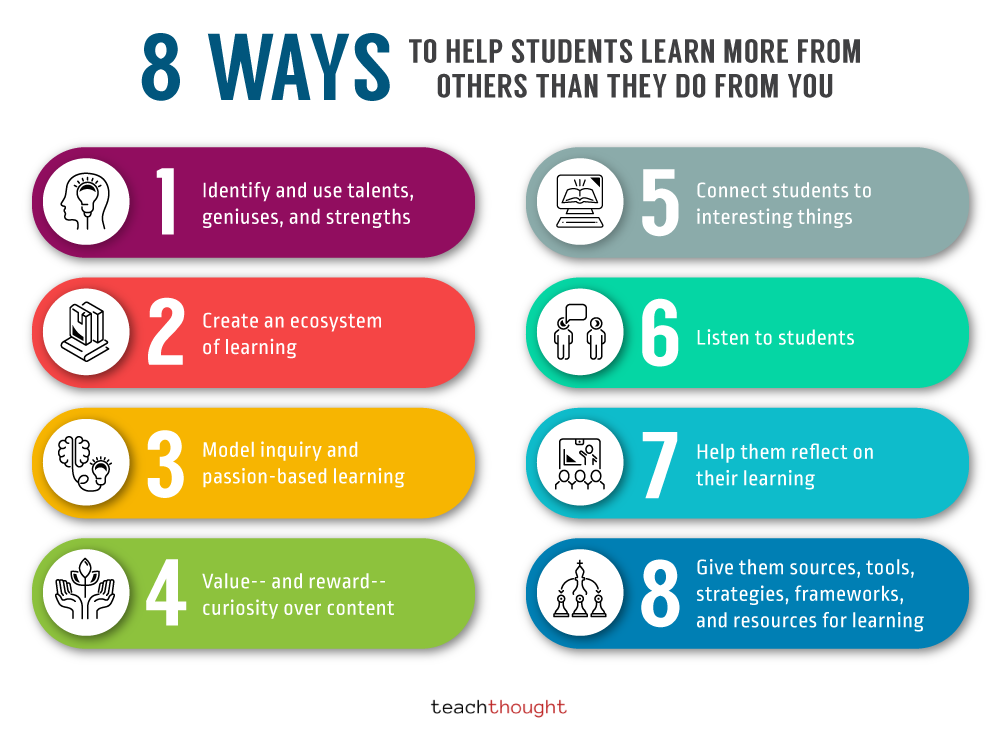
The basic property is that contemporary understanding is, in huge part, regarding gain access to, networks, areas, and personalization– and there’s just no way for a single teacher to ‘do’ this. As a matter of fact, it is very important to note that training, as it is, has never been sustainable. Public education guarantees too much and puts far as well big of a burden on classroom teachers who do their ideal to accomplish those ‘guarantees’ while shielding and supporting children and it simply does not truly work well for anyone.
I expect it could be said that it does, in fact, work well but we ‘d have to merely consent to disagree then– which is okay. It takes a mosaic of point of views to make the globe go.
Just recently, I upgraded that message and shared it on social networks and was surprised to instantly get urgent, stinging pushback.
Carl Marks (pen names? He is a history instructor, besides if his username can be decoded) made use of emojis to communicate his difference.
Liane got straight to the factor with a full-on dismissal of both the idea and of TeachThought as an organization– and ended with drip of sarcasm on the way out.
This from Anthony Jones had not been mean yet briefly shoots down the article.
This response from Sunne of York was less neutral:
Listed below, Brendan asked for research and proof to sustain the ideas in the blog post:
Fair enough. I can not sustain each product with current, peer-reviewed and qualified study. That’s true. Yet the basic facility that instructors are over-worked which kids (normally) have unbelievable access to more information than ever and that somehow the last might help boost the previous hopefully doesn’t need sustained with research study.
Rationale right here is to link pupils with a community of details, ideas, people, and ideas. Which these concepts and opportunities and places and individuals and concepts ought to be extra ‘impactful’ and ‘engaging’ than a single educator.
That can’t perhaps be controversial, can it?
Are Educators ‘Bottlenecks’ Or Are They ‘Worn’ And What’s The Distinction?
In the introduction, I established the context:
“Who or what is one of the most consistent driver in the process of learning? Frequently, it’s possibly you (the instructor). You’re the professional on both material and rearing. You understand what’s being discovered, and exactly how it might be ideal learned. Giving pupils full autonomy in their very own discovering might be great for inspiration, yet that can be a problem for a range of reasons. The instructor is finite. The instructor is limited. The educator has ‘self-bias’– sees things from their point-of-view regardless of just how hard they attempt to show compassion. In a teacher-centered classroom, the instructor is the bottleneck.”
But below is where I get closer to my ‘factor’: “The large concept here is sustainability by developing a community of learning that is based on imagination, passion, and possibility as brought to bear by trainees on subjects, problems, and possibilities they care about.”
Are Educators Important?
Obviously they are.
My assumption is that either some didn’t really read the blog post or they focused on the ramification that instructors should not be the facility of the discovering world which it’s it may not be optimal if, day in and day out, the most compelling and powerful and dynamic ’cause’ of discovering for 35 youngsters is one grownup (typically for 5 or even more classes a day).
I’m presuming it’s appealing to twist that declaration around a little and believe that I’m stating that teachers aren’t as reliable as other resources of knowing, maybe? Or that they’re not absolutely crucial to the discovering procedure? Or that books and applications are extra reliable than teachers?
Regardless of the resource of the misunderstanding (that I’ll approve obligation for), I would believe an educator would rejoice for kids to have the best: the very best discovering atmospheres with the absolute best possibilities to become their very best.
Why be distressed concerning that assists assist in that or that appoints what percentage throughout every one of the little bits and pieces of all of it?
And even if the idea was objection of teachers, as experts are we not due for and deserving of objection– ideally self-criticism
The Education We Have And The Education They Need
While mentally I’m much more curious about the nature of digital interactions– how easily individuals become awful to each other when the agreement is on social networks of some kind– I’ll react extra broadly instead to clarify my placement.
I am more than prepared to have large sections of any kind of target market differ with things I claim. I fundamentally believe that the way we (myself included) do points isn’t our best reasoning, which implies that what we’re doing and who is responsible for those activities, and exactly how we could enhance them are all naturally flawed.
This implies each of us is, to some extent, responsible and due to the fact that I have an interest in doing whatever I can to enhance these systems, often I am mosting likely to criticize organizational systems and principles and policies that are activated by people and several of those people could take it personally. And become distressed. I obtain it.
I additionally get that as if training had not been tough enough, the last 12 months have boosted the obstacle ten-fold. The task of ‘training’ is scholastic and mental and clinical all at once and each of those domains has actually been laid bare by global occasions (i.e., COVID and its countless sociocultural ripples). Educators are worried, pushed to their limits in a lot of cases, and lacking support, regard, thankfulness, financing, and countless other areas.
But this only enhances a key point: mentor, as it is, is neither lasting neither in the very best passion of the majority of children. No matter how hard we function, what we have and do isn’t the education and learning they deserve and require.
How teachers think of themselves and their function in the classroom matters (see here, for example). As a teacher, I ‘d want assistance. I would certainly desire automations and human networks and live streaming and flexible knowing algorithms. To promote understanding in whatever kind.
While I hope I directly have an impact on the lives of trainees, I hope it takes place by proxy.
After assisting my pupils find phrase structure and Faulkner and tone and Toni Morrison and Emily Dickinson and thematic advancement and Shakespeare, I ‘d be more than a little let down if the most long-lasting impression of their time in my class– amongst every one of the authors and ideas and jobs and words and questions and conversations– was me.